


Why is the oud so popular in the Middle East?



In the world of musical instruments, few instruments have the rich history and resonant charm of the oud. With its ancient origins and timeless voice, the oud stands as a bridge between cultures, a testament to human creativity, and an important actor in the development of different types of music, especially in the Arab and Middle Eastern traditions. In this article we learn about this instrument, its history and its influence on Western musical instruments.
Show key points
- The oud is an ancient stringed instrument with roots in Persia that played a significant role in shaping Arab and Middle Eastern musical traditions.
- Its name, derived from the Arabic word for "wood," reflects both its main construction material and the traditional wooden pick used to play it.
- Historically evolving from a three-string design to more complex variations with up to thirteen strings, the oud's structure greatly influences its deep, expressive sound.
- ADVERTISEMENT
- Unlike modern guitars, the oud's fretless neck allows for seamless note transitions, contributing to its signature emotional and melodic richness.
- The oud was introduced to Europe through Andalusia during the Umayyad rule and inspired the development of Western instruments like the lute.
- The fusion of the oud and guitar into a hybrid instrument demonstrates how musical traditions continue to evolve through cross-cultural innovation.
- The oud has transcended geographic and cultural boundaries, securing its place in both traditional and contemporary music across the globe.
Exploring the origin and essence of the oud:

Oud dates back to ancient Persia and spread to the Arab world during the Islamic Golden Age. The word 'oud' in Arabic denotes "wood", referring to the wooden feather traditionally used to play the oud, or to the material from which the instrument is made. In fact, the body of the oud is often made of a mixture of wood types, which noticeably affects the tone of the instrument. The richness of the Oud's history gives it a sense of authenticity and tradition that few other instruments can match, and its resonant and warm tones evoke a variety of emotions. It is no wonder that the oud has occupied an important place in the musical traditions of countries from North Africa to the Arabian Peninsula and beyond.
Recommend


Oud manufacturing - a frame for expression:

The design and manufacturing history of the oud is essential to its unique sound. The oud is usually fitted with eleven strings grouped into six groups, five of which are double-stringed and the sixth is composed of a often single chord, the thickest, called the bam. But there are some models with five sets or seven sets of strings, 10 strings, or 13 strings, to create deeper, more complex sound. But the oud has not always been like this. In pre-Islamic Persia, Arabia, and Mesopotamia, stringed instruments contained only three strings, with a small musical box and a long ulna with no adjustment pegs. But during the Islamic era, the music box was enlarged, a fourth chord was added, and the base of tuning pegs was added. In the early centuries of Arab civilization (pre-Islam), stringed instruments had four sets of one string in each. As early as the ninth century a fifth chord was added to complete the Octavian range. He was louder, and the lowest position in his relationship with other strings. Modern tuning maintains the old string sequence, with additions (lowest or highest cycles), which can be adjusted differently according to local or personal preferences.
Unlike modern guitars, the oud lacks breaks between notes, allowing musicians to glide seamlessly between notes and produce melodies that add distinctive depth and originality to Arabic music. As mentioned earlier, the body of the oud is often made of a mixture of wood types, and this distinctive design is the reason for the unique resonance of the oud. Traditionally, oud strings are attached to the bridge instead of using bridge pins. This stabilization method enhances the flexibility of the strings, enabling the instrumentalists to achieve expressive nuances in their playing. In addition to being used as an accompanying instrument, the oud often assumes a melodic role in orchestras. His ability to convey expressive melodies makes him a powerful solo instrument. It provides a crucial foundation for musical sentences ranging from traditional folk songs to complex classical compositions. It is this ringing of the oud sound that makes its popularity go beyond the Middle East to other countries and cultures of the world.
The spread of oud in Europe:
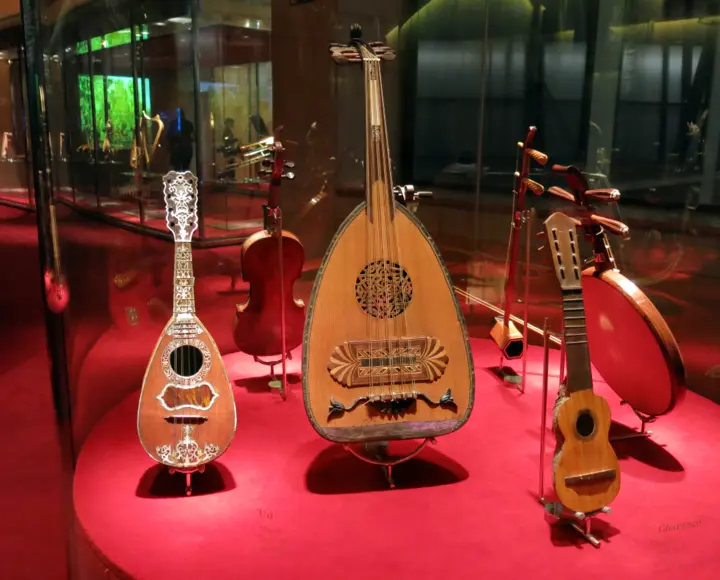
When the Umayyads conquered Andalusia in 711, they brought the oud with them. During the eighth and ninth centuries, many musicians and artists from all over the Islamic world flocked to Andalusia. Among them was Abu al-Hasan 'Ali ibn Nafi' (789–857), alias Ziryab, a prominent musician who trained under Ishaq al-Mawsili (b. 850) in Baghdad and was exiled to Andalusia before 833 CE. By the eleventh century, the Muslim Iberian Peninsula had become a center for the manufacture of musical instruments. These instruments gradually spread to southern France, influencing French poets and musicians, and eventually reaching the rest of Europe. While Europe developed the Western oud, or lute, the oud remained an essential part of Arabic music, as well as Ottoman music, and underwent a series of transformations that continued to sing it.
Oud and guitar fusion - a harmonious combination:
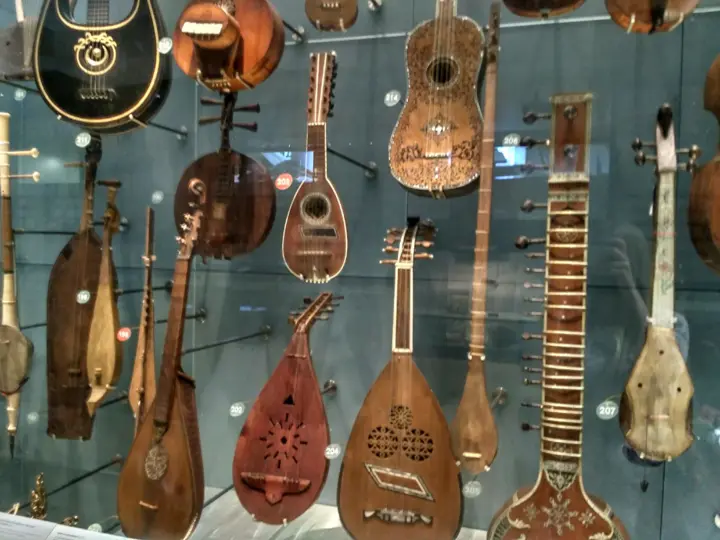
Often referred to as the prototype of the modern guitar, the oud features a distinctive pear-shaped body and a short ulna, but without commas like those on the guitar trigger to separate the musical half-dimensions. However, the link between the oud and the guitar is undeniable. As the two instruments developed over the centuries, they shared ideas and techniques, enriching each other's musical vocabulary. This exchange is manifested in the oud guitar, a fusion of the two instruments that combines the distinctive resonance of the oud with the usual guitar ulna intervals. This innovative instrument aims to provide a compromise for musicians who are used to playing the guitar but are attracted by the distinctive timbre of the oud and its melodic potential. They can be useful for guitarists who want to experiment with Middle Eastern or Arabic musical styles without adapting to the traditional interval-free oud zend. The creation of this instrument reflects the continuous evolution of musical instruments and the desire to blend cultural traditions with contemporary playing techniques.
Although the main entry of oud was in Western Europe, which led to a variety of oud styles, oud entered Europe in the East as well; as early as the sixth century, the Bulgarians brought a short-necked instrument called qamoz to the Balkans, which may be the basis of the bouzouq used in the East as well.
![]()
Why do most restaurant and café projects fail?
Why Most Cafes & Restaurant Projects Fail? more- ADVERTISEMENT
![]()
A book that may interest you - stop pleasing others
A book that might interest you - Stop People Pleasing more- ADVERTISEMENT
![]()
9 reasons why small businesses fail
9 reasons why small businesses fail more- ADVERTISEMENT
![]()
Shocking fact: the moon is moving away from the earth!
The Moon is slowly drifting away from Earth—about 3.8 cm each year—due to tidal friction. This subtle shift has been proven through laser technology since 1969. While it won't escape Earth’s gravity, the distancing affects Earth's rotation, making days longer and altering tides and seasonal temperatures. more- ADVERTISEMENT
![]()
75% of the global diet is produced by just 12 plants and 5 different animals
Our diets rely on just a few crops, making them fragile and less nutritious. Embracing lesser-known, diverse foods like millet and winged beans can boost health, support farmers, and protect against climate and crop threats. more- ADVERTISEMENT
![]()
Elon Musk's Brain Chip - Facts and Oddities
Elon Musk's Neuralink has stirred buzz with its brain chip, Brain-Link, aiming to let humans control devices with their minds. Though still experimental, early tests show promise—like a paralyzed person using it to control a computer—while sparking ethical concerns over privacy, safety, and equality. more- ADVERTISEMENT
![]()
National Museum of Qatar and the distinctive design of the desert rose
The National Qatar Museum and its Unique Desert Rose Crystalline Structure more- ADVERTISEMENT
![]()
How to learn any language in a short time? 8 practical tips
There’s no quick fix for learning a language, but with steady effort and the right methods—like setting goals, practicing daily, or using apps like Duolingo—you’ll improve with time. Surround yourself with the language and focus on real-life use rather than just grammar. more- ADVERTISEMENT
![]()
A river pushes the summit of Mount Everest up
Mount Everest, rising over 8,848 meters, stands as a giant shaped by tectonic power. Though rivers usually erode, a thought-provoking idea explores if sediment buildup could subtly aid Everest’s growth. This fascinating concept highlights how even opposing natural forces—like erosion and uplift—can together shape the Earth’s greatest peaks. more- ADVERTISEMENT
![]()
What are the reasons for the failure of entrepreneurship?
Entrepreneurship is tough, with many startups failing due to poor planning, weak management, and financial issues. Lack of market research, leadership skills, and funding are key setbacks. Business incubators can help by offering mentorship, workspace, and resources to boost success chances. more- ADVERTISEMENT