

Agadez Historic Centre, a fascinating African heritage site in Niger



On the southern tip of the Sahara Desert, among the sand dunes of Niger, is the city of Agadez, known as the "Gateway to the Desert". The city of Agadez was founded in the fifteenth century AD with the emergence of the Irian Amazigh Sultanate, which was ruled by the Tuareg tribes, and in the heart of the city is the historical center of Agadez, which brought together many historical monuments of that era and its aftermath, so that the historical center of Agadez is a historical shrine and archive for a golden period in the age of West Africa. The historic center of Agadez, an important crossroads of caravan trade, is divided into eleven quarters in irregular shapes. It contains several earthen dwellings and a well-preserved collection of stately and religious buildings including a 27-meter-high minaret made entirely of mud brick, the tallest such building in the world. The site is characterized by ancestral cultural, commercial and craft traditions that are still practiced today and offers exceptional and sophisticated examples of earthy architecture.
Recommend


Show key points
- Agadez, located on the southern edge of the Sahara in Niger, emerged in the 15th century with the foundation of the Sultanate of Ayr and became a major center for Tuareg tribes and trans-Saharan trade.
- The historic center of Agadez, with its eleven irregularly shaped quarters, preserves a unique ensemble of mudbrick buildings, including the tallest terracotta minaret in the world at 27 meters.
- Its architecture features intricate earthen designs that reflect a blend of urban and Bedouin styles, centered around religious and political monuments that still stand today.
- ADVERTISEMENT
- Agadez continues to uphold cultural, commercial, and artisan traditions that date back centuries, retaining its identity as a living historic city of approximately 20,000 inhabitants.
- Recognized as a UNESCO World Heritage Site in 2013, Agadez has increasingly attracted tourists, drawn by its preserved historical character and vibrant local crafts market.
- Despite its authenticity, the site faces preservation challenges due to modern materials, infrastructure modifications, and the need for consistent enforcement of building regulations.
- Efforts are ongoing to maintain key structures, with community involvement and conservation units playing a crucial role in protecting Agadez's architectural heritage and cultural significance.
The city of Agadez was built along caravan routes before the fifteenth century and boasts a rich variety of architectural styles. The earthen architectural houses built around the Grand Mosque are decorated in various intricate shapes and patterns. The minaret of the mosque is one of the tallest terracotta structures in the world.
Agadez's geographical location
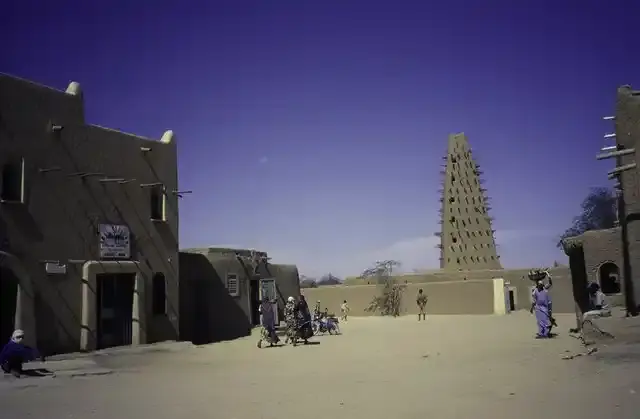
Agadez is a small town on the edge of the Sahara desert in the Ayr region of northern Niger. Its historical center dates back to the fifteenth and sixteenth centuries when the Sultanate of Ayr was founded there, encouraging the establishment of Tuareg tribes and the development of trans-Saharan economic and cultural exchanges through Agadez. It remains an "important gateway to the Sahara" in northern Niger, located on one of the few trans-Saharan routes that reach Algeria and the Mediterranean coast.
Agadez is a World Heritage Site
The World Heritage Site of Agadez covers an area of private residences, old mosques and stately buildings constructed with traditional mudbricks. Its most famous structure is the 27-meter-high pyramid minaret, which is believed to be the tallest all-terracotta minaret in the world. The design of the streets follows the boundaries of the original historic Tuareg camps as they were when the settlement process began, with eleven irregularly shaped "neighborhoods". In this area, a group of 18 major sites have been identified as of particular historical and cultural interest. It includes the mosque, Sultan Air Palace, several old squares and noteworthy private residences, as well as three other mosques in the city.
The outstanding global significance of the historic centre of Agadez
The history of the historic center of Agadez dates back more than 500 years, when the Sultanate of Ayr established itself there, which served as the seed around which the Tuareg tribes gathered who established economic and cultural exchanges across the Sahara and around former camps. The historic centre boasts a large amount of residences, and a well-preserved stately and religious ensemble, including a tall minaret made entirely of mud. The Old Town features the terracotta architecture and decorative style of the Ayr region. The traditional sultan's system remains in place and ensures social unity and economic prosperity. It is a living historical center inhabited by about 20,000 people.
Since the fifteenth century, Agadez, the "gateway to the desert", has become an exceptional crossroads for caravan trade, as it bears witness to an early historical city and is a major center for cultural exchanges across the Sahara. Its structure embodies a blend of authentic urban and Bedouin influences, made entirely of clay bricks.
The tallest clay minaret in the world
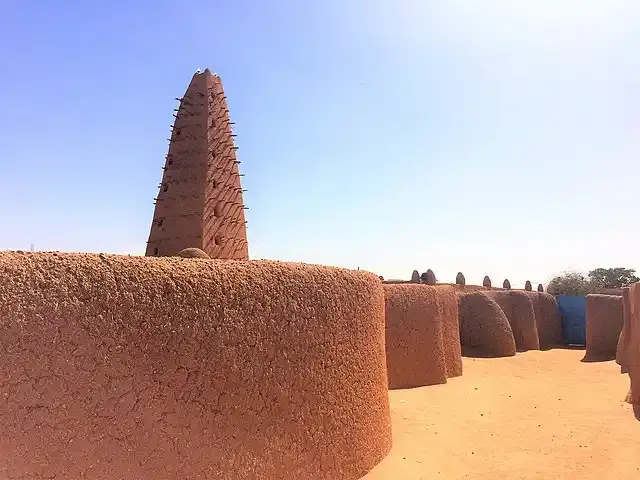
The mosque of the historic city of Agadez has the tallest clay minaret ever built, and features an exceptional architectural tradition based on the sophisticated use of clay blocks. More than five centuries ago, the city developed a high cultural and commercial tradition and craftsmanship that has become a hallmark of the influence of the Sultanate of Ayr, to this day.
Cultural mixing in Agadez
The historic centre contains well-preserved evidence of the general urban fabric, centered around the political and religious monuments associated with the Sultanate of Ayre, and a large number of houses (the majority easily) have been preserved, allowing appropriate expression of the specific values associated with the terracotta architecture and decoration of the Ayr region. The historic center of Agadez has good visual coordination from many lookouts, and gives the visitor a sense of being in a historic city with great integrity and reputation. However, there are some local modifications such as modern buildings, the use of corrugated iron for roofs, an overhead power cable network, and the appearance of large advertisements painted on the walls.
The originality of the constituent parts of the property is generally satisfactory, especially for monuments and palaces, with the exception of windows and door frames, which have often been renovated using unconventional materials. The authenticity of the housing is good, but it is also threatened by the use of modern materials such as cement-based plasters, metal elements and corrugated metal, and the appearance of painted advertisements.
Religious monuments and palaces are well maintained, under the responsibility of district chiefs. In the case of antique houses, the situation is more diverse. City planning regulations for properties within the protected perimeter have recently been established; however, building permit regulations must be implemented in both a homogeneous and educational manner, so that residents are informed about the importance of monumental buildings and the maintenance efforts needed to preserve them. The Property Conservation and Management Unit must be finalized and the Unit must be adequately staffed and materials.
Agadez is the best tourist destination in Niger
The center of Agadez has become the focus of attention of tourists from all over the world since it was accepted on the UNESCO World Heritage List in 2013, which has greatly increased its popularity due to its great distinction as a crossroads of caravan trade and a center for trans-Saharan cultural exchange.
Tourists enjoy seeing the stretching sandy alleys lined with red and yellow colored antique houses, and the market, which contains many traditional industries passed down through generations.
![]()
Why can't bots click on the "I'm not a robot" box on sites?
Why Can’t Robots Click the 'I’m Not a Robot' Box on Websites more- ADVERTISEMENT
![]()
Alert from the Northern Lights: Sun's activity is at its highest level in 23 years with the Northern Lights
Alert from the Northern Lights: Sun's activity is at its highest level in 23 years with the Northern Lights more- ADVERTISEMENT
![]()
3 inspiring success stories in difficult times
Fred DeLuca’s journey from washing dishes to founding Subway proves that persistence can turn a simple idea into a global empire, while Steve Jobs and Paulo Coelho show how resilience in the face of setbacks can lead to world-changing success and creative brilliance. more- ADVERTISEMENT
![]()
Discover the Impossible: Turning Deserts into Dense Forests – Dream or Reality?
Desert greening is turning deserts into lush forests using smart water techniques, solar and wind farms, and fertile soil solutions like pyrogenic carbon. Projects like the Sahara Forest Project aim to fight drought, boost agriculture, and even combat climate change, turning drylands into thriving ecosystems. more- ADVERTISEMENT
![]()
Success Guide - How to tame anxiety, stress and work stress?
Feeling overwhelmed by anxiety, stress, or work pressure? This simple guide offers practical steps like deep breathing, walking, quality sleep, setting boundaries, and staying organized to help you cope and regain balance. Remember, small changes can make a big difference—and you're not alone. more- ADVERTISEMENT
![]()
The concept of financial liberalization - how can you achieve it?
The Financial Freedom Concept - How can you achieve it more- ADVERTISEMENT
![]()
AI inspires creativity: artists and musicians use AI for their creations
AI is reshaping creativity, helping artists and musicians explore new styles and techniques. Tools like Soundraw let anyone compose music quickly, while artists like Ruby Barat use AI to transform classic art. Though some fear it may dilute originality, AI is opening bold new paths in creative expression. more- ADVERTISEMENT
![]()
What are smart laptops? Is it really practical?
What are smart laptops? Is it really practical? more- ADVERTISEMENT
![]()
5 electronic games to develop your skills and intelligence
Discover how video games like SimCity, Stardew Valley, and Gorogoa can sharpen your mind, boost creativity, and help with planning and decision-making—all while having fun. Not all games are just for play; some are powerful tools for personal growth and learning. more- ADVERTISEMENT
![]()
Unbelievable Interference of AI! Including garbage analysis!
From analyzing garbage to find eco-solutions, to helping a man find his wife, and even powering electric shoes that boost your walking speed—AI is doing some unbelievable things! These creative uses show just how far artificial intelligence can go beyond traditional boundaries. more- ADVERTISEMENT