

Ancient Mars Lake: an aquatic world larger than any on Earth



Mars has always amazed humanity with its red tint and mysterious landscapes. As the exploration of the Red Planet progresses, each discovery reveals the secrets of its ancient past. One of the most important discoveries is the existence of an ancient Martian lake, once larger than any lake on Earth. The discovery has reshaped the understanding of Mars, suggesting that the planet may have been more Earth-like in its early history, with vast bodies of water, and possibly favorable conditions for life. This article delves into the exploration and discovery of this ancient Martian lake, the nature and geography of Mars, the characteristics of its lakes, and the comparison of this vast area of water to that on Earth.
Recommend


Show key points
- The discovery of a massive ancient lake in Mars’ Gale Crater suggests the planet once had a climate capable of supporting stable liquid water
- Mars was likely much more Earth-like in its early history, featuring rivers, lakes, and possibly conditions suitable for microbial life
- Missions like the Curiosity rover and Mars Reconnaissance Orbiter uncovered evidence such as sedimentary layers and deltas that confirm past water activity
- ADVERTISEMENT
- This ancient lake was larger in surface area than any lake on Earth but relatively shallower, offering insights into Martian geography and hydrology
- The gradual loss of Mars’ atmosphere transformed its once-warm and wet climate into the cold, dry environment observed today
- Discovering organic molecules in Martian sediments strengthens the theory that Mars may have supported life in its ancient past
- Current and future missions, including the Perseverance rover, aim to uncover biosignatures and further study ancient water systems to understand Mars' habitability.
1. Mars exploration and discovery.
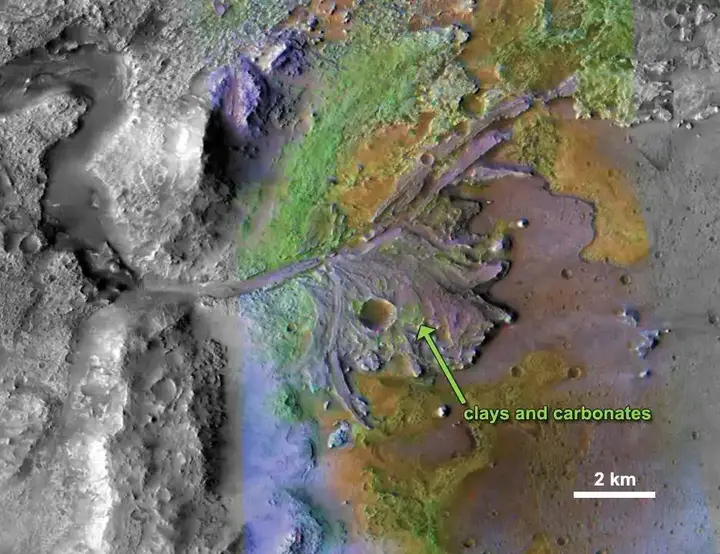
The exploration of Mars began in earnest with the advent of space technology in the middle of the twentieth century. NASA Mariner missions in the sixties provided the first close-ups of the surface of Mars, revealing a dry, barren world characterized by craters, valleys and dust storms. However, it was later missions, such as the Viking program in the seventies, the Mars Reconnaissance Orbiter MRO, and Curiosity, that began to uncover evidence suggesting that Mars once contained liquid water. These missions discovered signs of ancient river valleys, delta formations, and mineral deposits formed in the presence of water, leading scientists to hypothesize that Mars was once a wetter planet.
2. The nature and geography of Mars.
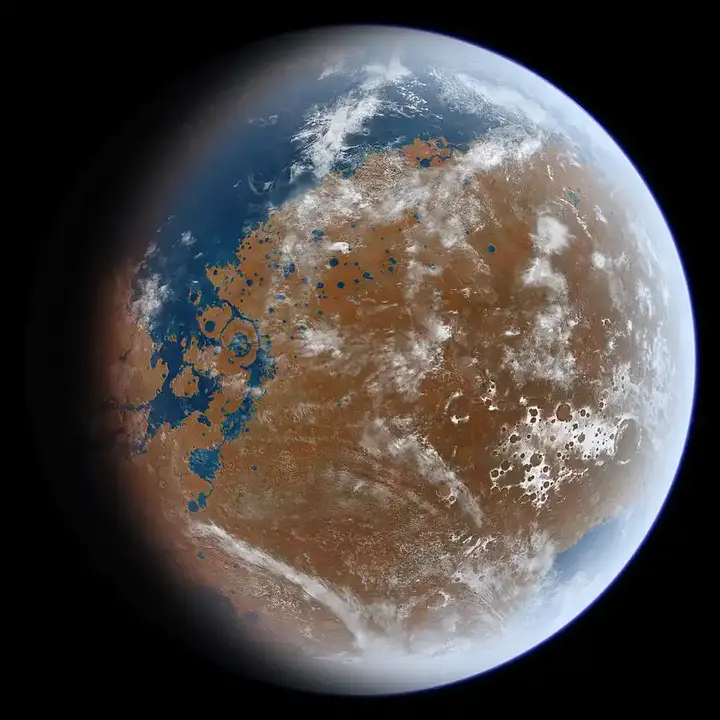
Mars is the fourth most distant planet from the Sun and the second smallest planet in the solar system. Mars has a thin atmosphere composed mostly of carbon dioxide, and surface temperatures range from -125 to 20 degrees Celsius (-195 to 68 degrees Fahrenheit). The planet's landscape consists of a combination of vast plains, towering volcanoes, and deep valleys, including Mount Olympus, the largest volcano in the solar system, and the Marineris Valleys, a system of valleys that dwarf the Grand Canyon. Mars also has polar ice caps consisting of water and dry ice, expanding and receding with the seasons.
3. Martian lakes and the discovery of the ancient Martian lake.
The discovery of ancient lakes on Mars was one of the most groundbreaking discoveries in planetary science. These lakes are thought to have existed billions of years ago when Mars had a thicker atmosphere and a milder climate. The largest of these ancient lakes was discovered in what is now the Gale crater explored by Curiosity. Scientists believe that this lake existed millions of years ago and that it fed on rivers, creating a stable environment that could have supported microbial life.
4. The geography and area of the ancient Martian lake.
The ancient Martian lake in Gale Crater was a sprawling expanse of water that stretched across much of the crater's diameter of 154 kilometers (96 miles). The lake fed on rivers carrying sediment from the surrounding highlands, resulting in the formation of delta formations and the deposition of layers of clay-rich minerals on the lake floor. These sediments suggest that the lake was neutral to slightly alkaline, similar to Earth's oceans, making it hospitable to life. The size of the lake and the depth of the sediment layers suggest that it lasted a long time, perhaps hundreds of thousands to millions of years, before drying up as the Martian climate changed.
5. Comparing the ancient Lake Mars with the lakes of Earth.
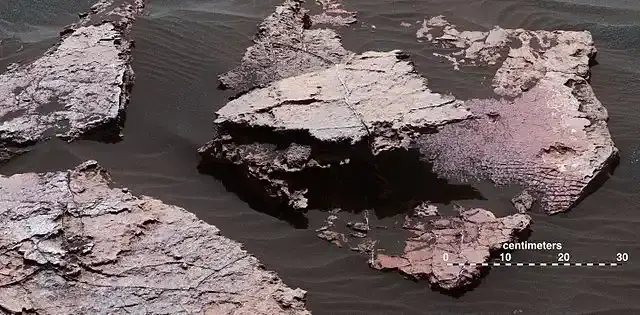
The size of an ancient Martian lake exceeds any lake on Earth. It is estimated that the lake in Gale Crater covered an area of more than 150,000 square kilometers (57,915 square miles), making it larger than the largest body of fresh water on Earth, Lake Superior, which covers 82,100 square kilometers (31,700 square miles). However, Lake Mars was shallower than many of Earth's lakes, with a maximum depth of 1.6 kilometers (about one mile), comparable to Lake Baikal in Siberia, the deepest and oldest freshwater lake on Earth. The fact that such a vast and permanent lake exists on Mars has profound implications for understanding the history of the planet and its potential to support life.
6. The climate of Mars and the dryness of the ancient lake.
The existence of the ancient Martian lake was possible thanks to a climate completely different from the cold and dry conditions seen today on Mars. Early Mars had a thicker atmosphere, which would have supported warmer temperatures and allowed liquid water to exist on the surface. Over time, however, the Martian atmosphere became thin, perhaps due to the loss of magnetic field, which allowed the solar wind to de-atmosphericize. As the atmosphere thinned, the planet cooled, and water froze on the surface or evaporated into space, leaving behind the dry, desolate landscapes seen today.
7. Implications for the existence of life on Mars.
The discovery of such a huge ancient lake on Mars raises interesting questions about the possibility of life on the planet. On Earth, wherever there is water, there is life, even in the harshest environments. The long-standing presence of liquid water in the ancient Martian lake may have provided the stable conditions needed for the evolution of life. While no direct evidence of life has been found, the discovery of organic molecules in Martian rocks and the possibility of ancient hydrothermal systems at the bottom of the lake suggest that Mars may have once provided the possibility of microbial life. Future missions, including the search for biosignatures with the Perseverance rover, may reveal whether life existed on Mars.
8. Explore Mars in the future and search for water.
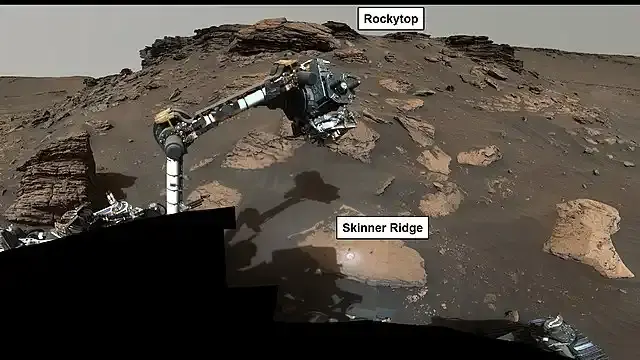
The discovery of the ancient Martian lake has led to renewed interest in Martian exploration, especially in the search for past or current water sources. NASA's Perseverance rover, which landed in Jezero Crater in 2021, was particularly tasked with searching for signs of ancient life and studying the planet's geology and climate. Jezero Crater was chosen because it also housed a large lake, and sediments there may hold evidence of Mars' aquatic past. In addition, humanity's plans to explore Mars, including the proposed mission to return samples from Mars, will focus on understanding the planet's history and future habitability.
The discovery of an ancient Martian lake larger than any lake on Earth has changed the understanding of Mars and the possibility that it supported the existence of life on it. This vast expanse of water, once located in the crater of Gale, provides compelling evidence that Mars was once an Earth-like planet, with a climate that enabled liquid water to exist on its surface for long periods. As Mars continues to be explored, each new discovery is close to revealing the secrets of its past, and determining whether life has taken root on this neighboring world. The ancient lake on Mars is a testament to the dynamic history of the planet and the interesting possibility that man is not alone in the universe.
![]()
Best Graphic YouTube Design Learning Channels in Arabic
Noor Design Channel stands out by teaching design basics like color theory in a hands-on way, helping many Arabs become skilled designers. It also guides learners on turning design skills into freelance work, making it a top pick for Arabic-speaking beginners. more- ADVERTISEMENT
![]()
Why is a minute divided into 60 seconds, an hour into 60 minutes, with only 24 hours a day?
Why is a minute divided into 60 seconds, an hour into 60 minutes, yet there are only 24 hours in a day? more- ADVERTISEMENT
![]()
The real signs of a very intelligent person
True Signs of a Highly Intelligent Person more- ADVERTISEMENT
![]()
A book that may interest you - don't be too nice
A book that might interest you - Too Nice for Your Own Good more- ADVERTISEMENT
![]()
Nemo Point: the most isolated location on the planet
Point Nemo, the ocean’s most remote spot, lies in the South Pacific, 2,700 km from any land. It’s so isolated that astronauts are often the closest humans. Known as a spacecraft graveyard, it’s also inspired fiction from Jules Verne to Gorillaz’s Plastic Beach album. more- ADVERTISEMENT
![]()
3 undeniable signs that you are on the right path
When fear grips you, isolation surrounds you, and strange coincidences start to appear—don’t worry. These are signs you’re on the right path. Embrace the journey, trust your growth, and remember: returning to your true self is the most magical part of it all. more- ADVERTISEMENT
![]()
25 Amazing Facts About Middle Eastern Culture
25 Amazing Facts About Middle Eastern Culture more- ADVERTISEMENT
![]()
A river pushes the summit of Mount Everest up
Mount Everest, rising over 8,848 meters, stands as a giant shaped by tectonic power. Though rivers usually erode, a thought-provoking idea explores if sediment buildup could subtly aid Everest’s growth. This fascinating concept highlights how even opposing natural forces—like erosion and uplift—can together shape the Earth’s greatest peaks. more- ADVERTISEMENT
![]()
The Search for the Lost Temple of Artemis: A Journey Through Time and Secrets
Hunting for the Lost Temple of Artemis-A Journey Through Time and Mystery more- ADVERTISEMENT
![]()
Explore the magic of Belfast: from ship history to contemporary art culture
Belfast blends rich shipbuilding history with vibrant culture, stunning modern architecture, and lively arts. From Titanic’s legacy to music festivals and scenic parks, the city offers unforgettable experiences. Stroll markets, enjoy local dishes, and soak in the warmth of a place where tradition meets creativity. more- ADVERTISEMENT