

Honoring Arab-American Heritage, Stories and Changemakers



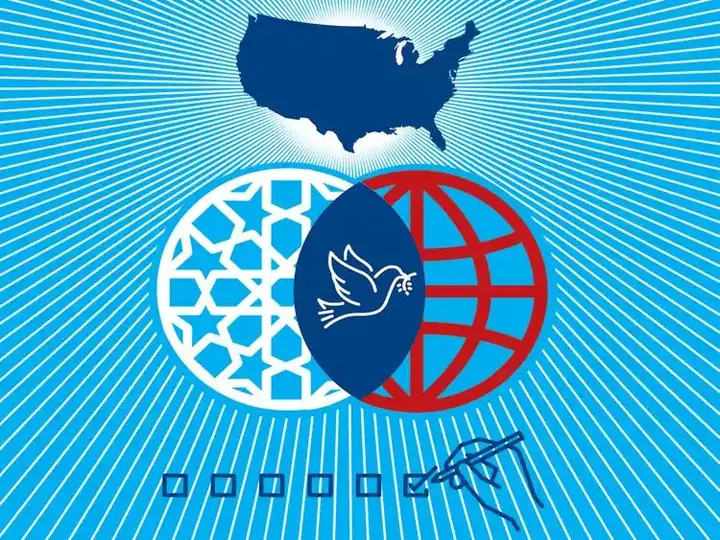
In 2022, President Biden officially declared April a month of Arab-American heritage. While the federal designation for this month is relatively new, the presence of people with Arab heritage in the United States dates back centuries. To celebrate this new commemorative month, Facing History organized the first American Heritage Month resource page to highlight Arab history in the United States, celebrate a group of Arab-American changemakers, and share other useful resources for teachers honoring this celebration in their classrooms. We look forward to bringing you more Arab-American heritage articles throughout the year.
Show key points
- April was officially designated as Arab-American Heritage Month in 2022 by President Biden to honor and celebrate the contributions of Arab Americans.
- Arab immigration to the United States began in the late 19th century, driven by economic prospects, conflict, and instability in the Greater Syria region under the Ottoman Empire.
- The early Arab immigrants were mostly Christian, poorly educated, and often had their names altered upon arrival in America.
- ADVERTISEMENT
- A second wave of Arab immigrants arrived post-World War II, largely Muslim and educated, fleeing political unrest and seeking academic and professional opportunities.
- While only 5% of Arab Americans prioritize the Israeli-Palestinian conflict in presidential voting, many see it as the most critical foreign policy issue today.
- Prominent Arab Americans, including poets, lawyers, comedians, and surgeons, have significantly influenced various cultural, scientific, and civil rights fields in the U.S.
- Arab Americans tend to hold favorable views toward Egypt, Turkey, and the UAE while showing more critical attitudes toward countries like Iran.
History reference
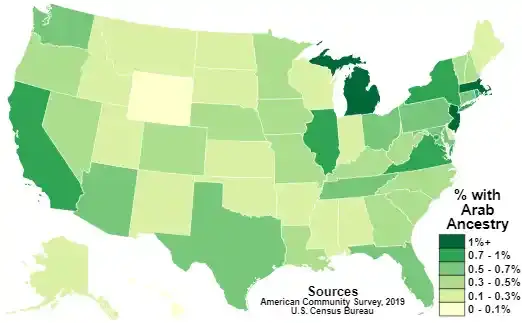
The mass immigration of Arabs to the United States began in the late nineteenth century, driven by promising economic opportunities, famine-induced migration, and a desire to escape political turmoil. The majority of these first immigrants came from the Greater Syria region of the Ottoman Empire, which includes present-day Israel, Jordan, Lebanon, Palestine and Syria. It is impossible to trace the actual number of Arabic-speaking immigrants who entered the United States before World War I, as customs officials classified people arriving through ports as Turks (which includes anyone coming from the vast Ottoman Empire at the time) or incorrectly as Asian, Greek, or Armenian. The first wave of Arab immigrants were predominantly Christian and often had little or no formal education. Like many newcomers to America before them, their names were often shortened and Americanized without full understanding or consent. At the turn of the century, these immigrants emphasized the importance of higher education for their American-born children, and encouraged their sons and daughters to pursue college and elite careers. The second wave of immigrants from the Middle East to the United States came after the end of World War II and the easing of restrictions under the Immigration Act of 1965. From 1948 to 1966, some 80,000 Arab immigrants made the United States their new home. Initially, many of these immigrants were ethnic Palestinians displaced by the 1948 Arab-Israeli war. Later, after 1965, they were followed by Egyptians, Syrians, Iranians, and Iraqis, who often fled political revolutions or government coups. In contrast to the first wave of Arab immigrants, this new wave was predominantly Muslim and educated—making the promise of American higher education opportunities and professional freedom so tempting.
Recommend


Views on the Middle East
Compared to a list of 14 major political issues, only 5 percent of Arab Americans rated resolving the Israeli-Palestinian conflict as a priority issue in determining their vote for the president — the only foreign policy issue on the list. However, 44% of respondents indicated that resolving this conflict was one of the most important foreign policy challenges facing the administration. In fact, this issue was ranked as the most important of the seven Middle East-related issues covered by the survey. In second place, with 33%, came "meeting humanitarian needs in Syria." "Addressing Lebanon's Political and Economic Crisis" came in third place with 28%. This was followed by ending the war in Yemen, improving relations with the Arab world, countering the threat posed by Iran, and stabilizing and rebuilding Iraq — which 16 percent to 11 percent of Arab Americans considered important. A strong majority of Arab Americans saw Donald Trump's handling of each of these foreign policy challenges as ineffective. By a margin of 48 percent to 32 percent, community voters said they believed Joe Biden would be the best at improving relations with the Arab world. When asked about their attitudes toward "the many countries across the Middle East playing increasingly important roles," Arab Americans were most inclined to Egypt, with 73 percent saying they had positive attitudes toward that country. Turkey came next, with 68 percent positive ratings, followed by the United Arab Emirates with 66 percent, Saudi Arabia with 56 percent, and Iran with 47 percent.
Prominent Arab Americans

Arab Americans have played a vital role in shaping modern America and have been leaders in social advocacy, scientific innovations, the arts and culture, and other defining moments in our world history. Meet some of the individuals who have helped elevate the stories and customs of Arab Americans and whose achievements have positively contributed to the fabric of our society.
1. Lawyer - Fatina Abd Rabbo
Abed Rabbo, an accomplished lawyer, serves as director of the League for the Defense of Muslims and Minorities of America (AMAL), a group that defends civil rights for all people and defends all forms of racism.
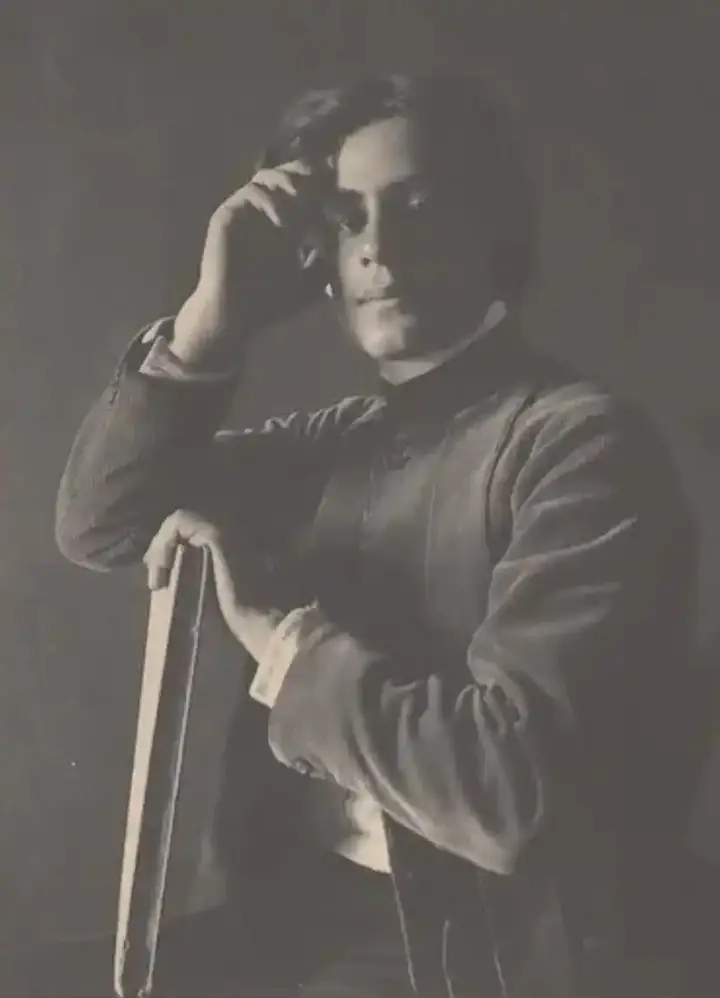
2. Poet and writer - Khalil Gibran
Gibran is the author of the prose poetry collection The Prophet, one of the best-translated and best-selling books of all time. In addition to his famous writings, which he did in both Arabic and English, he was also a successful visual artist.
3. Comedian Maysoon Zayed
Maysoon Zayed, a multi-talented artist, uses her expertise as a Palestinian-American and as a person with cerebral palsy to defend these minorities through comedy. She also delivered one of the most popular TED lectures of all time, with nearly a billion views.
4. The Surgeon - Michael Debke
While studying in medical school, Debke (originally named Dabbaghi) invented a life-saving device called a roller pump that allowed continuous blood flow to heart patients. His first innovations and discoveries in the field of vascular surgery have shaped his well-received career.
![]()
Princess Tower... The second tallest skyscraper in Dubai
Princess Tower in Dubai Marina stands out with its luxurious design, 101 floors, and stunning views. Once the tallest residential building in the world, it offers elegant apartments, top-notch amenities, and a prime location near shops and transport, making it a dream home and a solid investment. more- ADVERTISEMENT
![]()
Is the Nile the longest river in the world? Amazon would like the word.
The Nile is the world’s longest river- The Amazon would like a word more- ADVERTISEMENT
![]()
Quick tips to become a successful salesman
Success in sales comes from knowing your product, understanding customer needs, and building strong relationships. Always listen actively, communicate clearly, and stay passionate. Keep learning, stay organized, and never fear rejection—it’s just part of the journey to closing more deals and reaching your goals. more- ADVERTISEMENT
![]()
Career path in the age of technology: strategies for choosing the right specialty
Technology is reshaping careers, making it vital to align personal passion with future trends. Choosing the right major now demands strategic planning, continuous learning, and adapting to rapid changes. Fields like AI, cybersecurity, and data science offer great promise for those ready to embrace innovation and flexibility. more- ADVERTISEMENT
![]()
Learn how to learn: strategies to acquire difficult skills
Learning new skills is key to success today, but it’s not easy. Using practical strategies like learning by doing, setting clear goals, and using online tools can help. Overcoming frustration and staying motivated are also important for progress and creativity. more- ADVERTISEMENT
![]()
Sama Beirut... Unique skyscraper
Sama Beirut, Lebanon’s tallest tower, rises with elegance in Achrafieh, offering stunning sea and mountain views. Built by Fadi Antonios out of love for his homeland, it blends green space, luxury living, and modern safety features—all in one iconic landmark symbolizing hope and resilience. more- ADVERTISEMENT
![]()
The best economical graphics cards for gaming and content creation - available in the Arab world
Looking for strong gaming and content creation performance on a budget? The NVIDIA GeForce GTX 1660 Super and RTX 3050 stand out for 1080p, while the AMD RX 6700 XT and NVIDIA RTX 3060 Ti shine at 1440p. Great value options packed with smooth performance and essential features like ray tracing. more- ADVERTISEMENT
![]()
The Mamluks in the Arab World: History - Importance - Leaders and Decline
The Mamluks, once slave soldiers, rose to rule Egypt and Syria from 1250 to 1517. They defeated Crusaders and Mongols, revived the caliphate, and built stunning architecture in Cairo. Though conquered by the Ottomans, they remained influential, even challenging Napoleon before their final defeat in 1811. more- ADVERTISEMENT
![]()
3 inspiring success stories in difficult times
Fred DeLuca’s journey from washing dishes to founding Subway proves that persistence can turn a simple idea into a global empire, while Steve Jobs and Paulo Coelho show how resilience in the face of setbacks can lead to world-changing success and creative brilliance. more- ADVERTISEMENT
![]()
Marseille: the city where everyone belongs to another place
Marseille is a vibrant coastal city where cultures from around the world blend in daily life. From Arabic to French and Italian, its streets echo with languages and stories of migration, making it a unique place filled with diverse food, traditions, and peaceful coexistence among its residents. more- ADVERTISEMENT